
Methodological Frameworks for Experimental Validation and Scientific Data Assessment
The development of reliable scientific knowledge depends on the application of structured methodological frameworks capable of supporting experimental validation and systematic data assessment. Across contemporary research disciplines, methodological consistency, analytical precision, and appropriate evaluation procedures are essential for generating meaningful and reproducible scientific results.
Experimental validation involves examining the reliability of investigative procedures, evaluating measurement performance, and determining whether experimental observations adequately support the objectives of a research project. Scientific data assessment complements this process by providing analytical approaches for organizing, processing, comparing, and interpreting collected information.
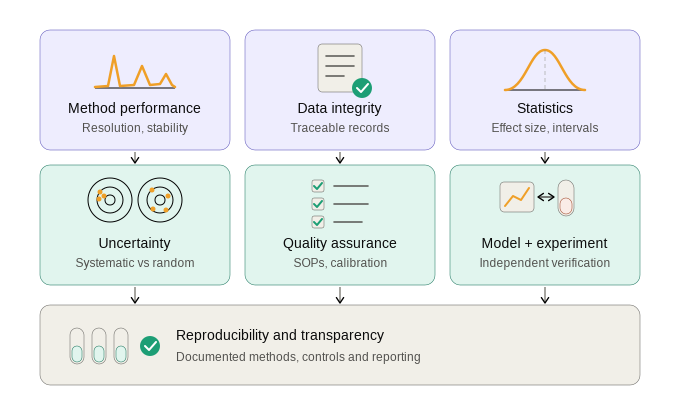
The integration of these principles establishes a comprehensive foundation for scientific investigation. By connecting experimental design, measurement procedures, quality assessment, statistical evaluation, and critical interpretation, researchers can strengthen the methodological quality of their work.
1. Principles of Scientific Methodological Frameworks
A methodological framework defines the procedures and analytical principles used to conduct a scientific investigation. It establishes a logical connection between research questions, experimental objectives, selected techniques, and expected analytical outcomes.
The development of an effective framework requires consideration of the scientific context, the nature of the investigated system, and the limitations of available methods.
Its principal components include:
Definition of research objectives and hypotheses.
Selection of appropriate experimental models.
Identification of relevant variables and measurement parameters.
Establishment of standardized experimental procedures.
Selection of analytical and statistical approaches.
Definition of validation and quality assessment criteria.
A structured methodological framework improves the organization of research activities and facilitates the comparison of findings obtained through different experimental approaches.
2. Experimental Validation and Measurement Reliability
Experimental validation is an essential process for evaluating whether an investigative method performs according to its intended purpose.
The validation strategy depends on the type of investigation and the characteristics of the measurement system. Analytical procedures, biological assays, physical measurements, and computational models require different validation considerations.
Several parameters are particularly important:
Accuracy: Determines how closely an experimental measurement corresponds to an accepted reference value.
Precision: Evaluates the consistency of repeated measurements under defined conditions.
Repeatability: Examines the agreement between measurements obtained using the same procedure, equipment, and operating conditions.
Reproducibility: Assesses whether comparable results can be obtained under appropriately varied conditions, such as different laboratories or operators.
Sensitivity: Describes the ability of a measurement procedure to detect small changes in the investigated parameter.
Robustness: Evaluates the capacity of a method to maintain acceptable performance when minor experimental conditions vary.
These characteristics provide important information about methodological reliability and help identify potential sources of experimental uncertainty.
3. Standardization of Experimental Procedures
Standardization establishes consistent conditions for conducting experimental investigations. It reduces unnecessary procedural differences and facilitates the interpretation of results across independent research activities.
Standardized operating procedures generally describe sample preparation, equipment requirements, reagent concentrations, experimental conditions, measurement sequences, and documentation practices.
In laboratory research, standardization may involve:
Consistent sample collection and preparation.
Defined incubation and reaction conditions.
Appropriate calibration procedures.
Standardized instrumental settings.
Documented measurement protocols.
Consistent recording of experimental observations.
Standardization is particularly important when several analytical techniques are integrated into a single research project.
Differences in experimental conditions can influence measurements and introduce variability that complicates the interpretation of scientific findings.

4. Analytical Method Assessment and Performance Evaluation
Analytical methods provide the experimental information required to characterize chemical, biological, and physical systems.
Their performance must be evaluated according to the analytical objectives and the characteristics of the investigated samples.
Chromatographic techniques, spectroscopy, mass spectrometry, microscopy, and molecular assays each provide specific types of information.
For example, chromatographic methods can be assessed through separation efficiency, retention-time consistency, resolution, and analytical response. Spectroscopic techniques require consideration of signal stability, background interference, and measurement sensitivity.
In molecular biology, the evaluation of quantitative PCR procedures may include amplification efficiency, specificity, reference gene stability, and consistency between technical replicates.
The selection of suitable performance indicators ensures that analytical methods are evaluated using criteria relevant to their intended application.
5. Scientific Data Quality and Integrity
Reliable scientific interpretation requires data that accurately represent the experimental observations.
Data quality encompasses several dimensions, including completeness, consistency, accuracy, traceability, and methodological transparency.
During experimental investigations, information should be recorded systematically to preserve the relationship between samples, analytical procedures, measurement conditions, and final results.
Important data management practices include:
Maintaining complete experimental records.
Applying consistent sample identification systems.
Recording instrument settings and calibration information.
Documenting deviations from established procedures.
Preserving original measurement outputs.
Implementing appropriate data verification procedures.
Data integrity also requires protecting experimental information from undocumented modifications and ensuring that analytical transformations can be traced and explained.
These principles support transparent research practices and facilitate independent examination of scientific findings.
6. Statistical Assessment and Quantitative Interpretation
Statistical analysis provides mathematical tools for evaluating experimental observations and identifying meaningful patterns within scientific datasets.
The choice of statistical method should be determined by the research question, experimental design, sample distribution, and characteristics of the collected variables.
Descriptive statistics provide an initial overview of datasets through measures such as the mean, median, standard deviation, and range.
Inferential statistical approaches allow researchers to evaluate differences between experimental groups and investigate relationships between variables.
Common techniques include:
Student's t-test for appropriate comparisons between two groups.
Analysis of variance for evaluating differences across multiple groups.
Correlation analysis for investigating relationships between variables.
Regression models for evaluating associations and predictive relationships.
Non-parametric tests for data that do not satisfy relevant parametric assumptions.
Multivariate statistical methods for examining complex datasets.
The interpretation of statistical findings should consider effect size, confidence intervals, sample size, assumptions, and potential sources of bias.
Statistical significance should not be considered independently of the scientific relevance of the observed differences.
7. Measurement Uncertainty and Experimental Variability
All experimental measurements are influenced by some degree of uncertainty.
Measurement uncertainty may originate from instrument limitations, sample heterogeneity, environmental conditions, reagent variability, operator-related differences, and procedural inconsistencies.
Understanding these factors is important for determining the reliability of experimental observations.
Uncertainty assessment can involve repeated measurements, calibration procedures, reference materials, statistical analysis, and evaluation of instrumental performance.
Experimental variability should also be distinguished from systematic measurement errors. Random variability can influence the dispersion of observations, whereas systematic errors may consistently shift measurements away from their expected values.
Recognizing these differences helps researchers select appropriate corrective procedures and improve experimental design.
8. Quality Assurance and Methodological Documentation
Quality assurance provides an organized framework for maintaining consistency throughout research activities.
It includes the implementation of documented procedures, appropriate quality controls, equipment monitoring, personnel training, and systematic evaluation of experimental performance.
In laboratory environments, quality assurance can involve:
Standard operating procedures.
Equipment maintenance and calibration.
Reagent and reference material documentation.
Internal quality control measurements.
Traceability of experimental samples.
Periodic methodological performance reviews.
Comprehensive documentation allows research teams to reconstruct experimental conditions and identify potential methodological deviations.
It also supports collaboration between laboratories and facilitates the transfer of established analytical procedures.
9. Integration of Experimental and Computational Validation
Modern scientific investigations increasingly combine experimental measurements with computational analysis.
Computational models can help evaluate complex relationships, identify patterns, and generate predictions that can subsequently be examined through experimental procedures.
For example, molecular modelling can provide structural hypotheses that are investigated using biochemical or biophysical techniques. Similarly, statistical models can identify relationships within experimental datasets that require further validation.
The integration of computational and experimental approaches requires careful consideration of model assumptions, input data quality, parameter selection, and validation procedures.
Independent experimental verification remains important when computational predictions are used to support scientific conclusions.
This complementary relationship contributes to more comprehensive research strategies and strengthens the interpretation of complex scientific systems.
10. Reproducibility and Research Transparency
Reproducibility is a fundamental principle of scientific reliability. It allows independent researchers to evaluate whether experimental findings can be obtained again under comparable methodological conditions.
Achieving reproducibility requires detailed methodological descriptions, appropriate experimental controls, transparent data analysis, and consistent reporting practices.
Researchers should document:
Experimental models and sample characteristics.
Materials, reagents, and equipment.
Analytical procedures and operating conditions.
Statistical methods and software.
Exclusion criteria and methodological limitations.
Deviations from the original experimental design.
Transparent reporting also requires distinguishing observed results from interpretations and hypotheses.
These practices support critical scientific evaluation and contribute to the development of cumulative research knowledge.

11. Emerging Approaches to Scientific Data Assessment
Advances in digital technologies are introducing new approaches to scientific data management and methodological evaluation.
Artificial intelligence and machine learning can support the identification of patterns, automated classification, image analysis, and predictive modelling.
Digital laboratory platforms can facilitate experimental documentation, sample tracking, and the integration of information generated by different analytical instruments.
Automated quality control systems may also help identify irregular measurements and monitor analytical performance.
However, emerging technologies require appropriate validation. Their reliability depends on data quality, algorithmic assumptions, computational performance, and the suitability of their intended applications.
Combining digital innovation with established scientific validation principles is essential for maintaining research integrity.
12. Future Directions in Experimental Validation
Future developments in experimental validation will increasingly emphasize integrated analytical systems, automated measurement procedures, advanced statistical methodologies, and improved data traceability.
The growing complexity of scientific datasets will require more effective approaches for combining experimental measurements with computational interpretation.
Greater attention will also be directed toward standardized validation criteria, transparent reporting, uncertainty assessment, and reproducible research workflows.
Interdisciplinary collaboration will remain important in developing methodological frameworks that can accommodate different experimental systems and analytical requirements.
Conclusion
Methodological frameworks for experimental validation and scientific data assessment provide essential foundations for reliable scientific investigation.
The integration of experimental standardization, analytical performance evaluation, statistical interpretation, data integrity, and reproducibility strengthens the quality of research findings.
By systematically examining methodological limitations and measurement uncertainty, researchers can improve the consistency and transparency of their investigative procedures.
The continued development of analytical technologies, computational approaches, and integrated quality assessment systems will further expand the possibilities of scientific validation.
Ultimately, rigorous methodological frameworks support the generation of reliable scientific knowledge and contribute to the advancement of applied research across multiple disciplines.