
Introduction
Scientific research is continuously evolving through the development of experimental strategies, analytical technologies, and interdisciplinary approaches. As scientific questions become increasingly complex, traditional investigative methods are often complemented by integrated research frameworks that combine experimental observation, quantitative assessment, computational analysis, and methodological validation.
The integration of different scientific approaches provides researchers with opportunities to investigate complex phenomena from multiple perspectives. By combining complementary experimental techniques and analytical procedures, scientific investigations can generate more comprehensive datasets, improve methodological consistency, and support the interpretation of complex research outcomes.
Advanced scientific research approaches therefore emphasize the importance of methodological selection, experimental optimization, data quality, and the systematic integration of scientific knowledge.
1. Foundations of Experimental Strategy Development
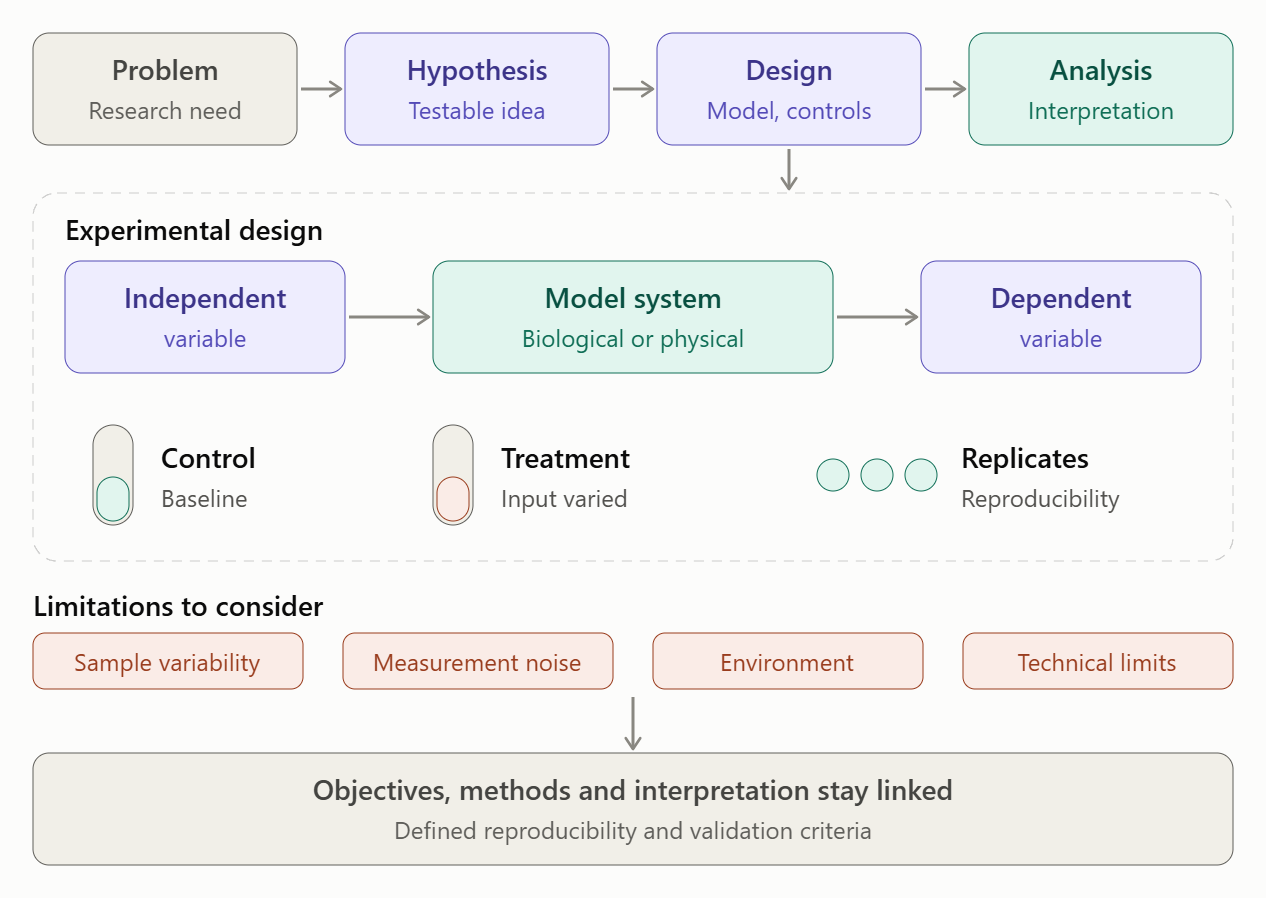
Experimental strategies establish the structure through which scientific questions are investigated. Their development begins with the identification of a research problem, the formulation of hypotheses, and the selection of appropriate investigative procedures.
A well-designed experimental strategy requires consideration of several interconnected factors, including:
Research objectives and expected outcomes.
Selection of experimental models and biological or physical systems.
Identification of independent and dependent variables.
Establishment of appropriate control conditions.
Selection of measurement and analytical techniques.
Definition of reproducibility and validation criteria.
Experimental planning also requires an understanding of potential limitations associated with the selected methodologies. Factors such as sample variability, measurement uncertainty, environmental conditions, and technical constraints can influence experimental outcomes.
Consequently, experimental strategies should be designed to provide a logical relationship between research objectives, methodological procedures, and the interpretation of collected information.
2. Integration of Complementary Experimental Techniques
Complex scientific investigations frequently require multiple experimental techniques to characterize different aspects of the same system.
In molecular and cellular research, for example, microscopy can provide structural information, biochemical assays can quantify molecular activity, and molecular analysis can investigate changes in gene expression. Combining these techniques allows researchers to examine relationships between cellular structures, biochemical responses, and molecular mechanisms.
In analytical chemistry, chromatographic separation may be combined with mass spectrometry to improve the identification and characterization of chemical compounds. Spectroscopic techniques can provide additional information regarding molecular composition and structural properties.
The integration of complementary methodologies offers several advantages:
Broader characterization of investigated systems.
Improved interpretation of experimental observations.
Identification of relationships between different measurements.
Reduction of dependence on individual analytical techniques.
Greater consistency between experimental findings.
However, combining methodologies also requires careful standardization to ensure that differences in sample preparation, measurement conditions, and analytical procedures do not introduce unnecessary variability.
3. Advanced Experimental Design and Optimization
Experimental design is an essential component of scientific investigation because it determines how research variables are organized and evaluated.
Traditional experimental approaches may investigate one variable at a time, whereas more advanced designs can examine multiple factors simultaneously. Factorial designs, response surface methodologies, and optimization models provide structured approaches for evaluating interactions between experimental parameters.
These strategies can be particularly useful when investigating complex systems in which several variables influence the final outcome.
For example, experimental optimization may involve examining:
Temperature and reaction conditions.
Sample concentration and preparation procedures.
Incubation periods and exposure parameters.
Instrumental sensitivity and measurement settings.
Environmental conditions and experimental stability.
Response surface methodology can help identify relationships between selected variables and experimental responses. This makes it possible to evaluate interactions and determine conditions that improve the performance of an investigative procedure.
A carefully optimized experimental design can also reduce unnecessary experimental repetitions and improve the efficient use of research resources.
4. Molecular and Biochemical Investigation
Molecular and biochemical techniques provide essential tools for investigating biological processes at different levels of organization.
Biochemical assays can be used to quantify enzyme activity, metabolic products, protein concentrations, and other molecular parameters. Molecular biology techniques, including polymerase chain reaction and quantitative real-time PCR, allow researchers to investigate genetic material and evaluate changes in gene expression.
Microscopy and cellular imaging provide complementary information by revealing structural modifications, intracellular localization, and morphological characteristics.
The combination of these approaches is particularly valuable when investigating relationships between molecular events and observable biological responses.
For example, the assessment of oxidative stress may involve measuring reactive oxygen species, evaluating antioxidant enzyme activity, examining lipid peroxidation, and investigating the expression of genes associated with cellular defense mechanisms.
Rather than relying on a single experimental measurement, researchers can combine these observations to develop a more comprehensive interpretation of the investigated biological response.

5. Analytical Instrumentation and Scientific Characterization
Advanced analytical instrumentation has significantly expanded the possibilities of experimental research.
Chromatography, mass spectrometry, spectroscopy, and microscopy provide complementary approaches for examining the chemical, structural, and physical characteristics of different samples.
High-performance liquid chromatography separates chemical constituents according to their interactions with stationary and mobile phases. Gas chromatography coupled with mass spectrometry supports the separation and identification of volatile compounds. Spectroscopic techniques provide information about molecular composition, chemical bonding, and structural characteristics.
Instrumental analysis requires careful attention to calibration, sample preparation, analytical conditions, and quality control.
Important methodological considerations include:
Instrument calibration and performance verification.
Selection of suitable reference materials.
Assessment of analytical precision and accuracy.
Evaluation of detection and quantification limits.
Identification of potential interference and contamination.
Standardization of data acquisition procedures.
These considerations contribute to the generation of reliable analytical results and support comparisons between independent experimental investigations.
6. Computational Approaches in Scientific Research
Computational methodologies increasingly complement conventional experimental procedures. They allow researchers to process complex datasets, simulate scientific systems, and investigate relationships between variables.
Statistical software and computational platforms can support data cleaning, visualization, hypothesis testing, and mathematical modelling.
In biological research, computational analysis can contribute to the investigation of molecular interactions, protein structures, genomic information, and cellular pathways. In materials science, numerical simulations can help examine structural behavior and predict physical properties under different conditions.
Machine learning approaches also offer opportunities to identify complex patterns in large datasets. Classification algorithms, regression models, and clustering techniques can support the organization and interpretation of experimental information.
Nevertheless, computational findings must be interpreted carefully. Model assumptions, data quality, training procedures, and potential biases can influence predictive performance.
The integration of computational analysis with experimental validation is therefore important for establishing scientifically meaningful conclusions.

7. Scientific Data Management and Quantitative Interpretation
Scientific investigations generate large quantities of information that require appropriate organization and analysis.
Data management begins with the systematic recording of experimental conditions, measurement procedures, sample characteristics, and analytical observations. Maintaining consistent documentation helps researchers trace the origin of results and evaluate methodological differences.
Quantitative interpretation involves selecting statistical methods that correspond to the research design and the characteristics of the collected data.
Common analytical approaches include:
Descriptive statistics for summarizing experimental observations.
Hypothesis testing for evaluating statistical differences.
Correlation analysis for investigating relationships between variables.
Regression analysis for examining associations and predictive relationships.
Multivariate analysis for evaluating complex datasets.
Data visualization for identifying patterns and presenting findings.
The interpretation of statistical results should consider sample size, variability, confidence intervals, assumptions, and potential sources of uncertainty.
Importantly, statistical significance does not automatically establish biological or practical significance. Scientific conclusions should therefore consider the magnitude of observed effects and their relevance to the original research question.
8. Methodological Validation and Reproducibility
Methodological validation is fundamental to the reliability of experimental research.
A scientific procedure must be evaluated to determine whether it consistently measures the intended parameter under defined conditions. Depending on the analytical context, validation may include assessments of accuracy, precision, selectivity, sensitivity, linearity, and robustness.
Reproducibility involves the ability to obtain consistent findings when an investigation is repeated using the same or appropriately comparable experimental conditions.
Several practices contribute to methodological reliability:
Developing standardized operating procedures.
Documenting experimental parameters in detail.
Including appropriate positive and negative controls.
Maintaining instrument calibration records.
Recording deviations and methodological limitations.
Applying suitable statistical procedures.
Sharing sufficient methodological information for independent evaluation.
Transparent reporting is equally important. Researchers should distinguish between experimental observations, statistical interpretations, and hypotheses that require further investigation.
These practices strengthen confidence in scientific findings and support the progressive refinement of research methodologies.
9. Emerging Technologies and Integrated Research Platforms
Technological innovation is transforming the way scientific investigations are conducted.
Automated experimental platforms can improve consistency in repetitive procedures, while high-throughput technologies allow researchers to examine large numbers of samples or experimental conditions within structured workflows.
Artificial intelligence is increasingly being explored for scientific image analysis, molecular prediction, pattern recognition, and the organization of complex datasets.
Other developments include advanced biosensors, automated microscopy, digital laboratory systems, and integrated analytical platforms.
These technologies can improve research efficiency and expand the scope of scientific investigation. However, their implementation requires careful evaluation of measurement reliability, computational assumptions, data security, and methodological limitations.
The most effective research frameworks combine technological capabilities with established experimental principles and independent validation procedures.
10. Interdisciplinary Collaboration and Research Development
Interdisciplinary collaboration provides opportunities to combine specialized knowledge from different scientific fields.
Biologists, chemists, physicists, engineers, statisticians, and computational scientists can contribute complementary expertise to complex research projects.
For instance, the investigation of a biological system may require molecular characterization, analytical chemistry, quantitative modelling, and advanced imaging. Each discipline contributes a different perspective that strengthens the overall research framework.
Effective collaboration depends on clear communication, compatible methodological standards, coordinated experimental planning, and consistent data documentation.
The integration of different scientific perspectives can also encourage the development of new analytical techniques and innovative experimental strategies.
11. Future Perspectives in Advanced Scientific Research
The future of scientific research will increasingly depend on the integration of experimental methodologies, computational technologies, and interdisciplinary knowledge.
Research platforms are expected to become more interconnected, allowing experimental measurements, analytical outputs, and computational models to contribute to unified investigative frameworks.
Important future developments include the expansion of automated experimental systems, improved data integration, advanced molecular characterization, and more sophisticated predictive models.
Greater attention will also be directed toward research transparency, methodological standardization, data reproducibility, and the responsible application of artificial intelligence.
The continued development of integrated experimental strategies will therefore play an important role in improving scientific investigation and addressing increasingly complex research questions.
Conclusion
Integrating experimental strategies and advanced scientific research approaches provides a comprehensive framework for investigating complex scientific phenomena.
The combination of experimental design, molecular investigation, analytical instrumentation, computational methodologies, and quantitative interpretation allows researchers to examine scientific systems through complementary perspectives.
Methodological optimization, validation, and reproducibility remain essential for ensuring the reliability of experimental findings. At the same time, technological innovation and interdisciplinary collaboration continue to expand the possibilities of applied scientific investigation.
Ultimately, the successful integration of complementary research approaches depends on maintaining a balance between methodological rigor, analytical precision, technological development, and critical scientific reasoning. This integrated perspective supports the advancement of reliable knowledge and contributes to the continuous evolution of contemporary research practices.